
hreflang checker for multilingual sites
Enter up to 20 URLs from one site. Leadee reads their hreflang tags from the HTML, the HTTP Link header and the XML sitemap, then follows the alternates on your site. You see bad language codes, missing return links, a missing x-default and canonical tags that fight hreflang.
Updated
- No email needed
- Free, no sign-up
3 issues
- /de/ links to /fr/, but /fr/ does not link back
- en-UK is not a region code (use en-GB)
- No x-default version is set
Example result
Run it now
At a glance
- 4 items
- What it checks
- 8
- Questions answered
- No email needed
- To get a result
- Is my site healthy?
- Answers
What does a result look like?
3 issues
- /de/ links to /fr/, but /fr/ does not link back
- en-UK is not a region code (use en-GB)
- No x-default version is set
Sample from a real run, 14 Nov 2026.
What does it check?
See the full methodology at /methodology for how every Leadee check is scored and weighted.
Language and region codes
Every code is checked against ISO 639-1, ISO 15924 and ISO 3166-1. Mistakes like en-UK or jp get the right code. Google Search Central, checked 14 November 2026.
Return links
If page A lists page B, page B must list page A. Google ignores tags that do not point both ways. Checked 14 November 2026.
x-default and self links
Each version should list itself, and the set should name an x-default page for every other language. Checked 14 November 2026.
Canonical conflicts
A version whose canonical points to another page, or a hreflang link to a URL that is not canonical, is flagged. Checked 14 November 2026.
HTML, header and sitemap
Tags are read from all three places Google accepts, and pages where they list different sets are flagged. Checked 14 November 2026.
Target URLs
Relative URLs, links that redirect, return an error or point to noindex pages, and one code with two URLs are reported. Checked 14 November 2026.
This checker reads the HTML your server sends, so tags added by JavaScript are not seen. Read JavaScript rendering for AI crawlers.
How do I read and fix the result?
Start with high findings: bad codes, missing return links, canonical conflicts and links to broken, redirected or noindex pages. Google may ignore the tags when these are wrong. Medium findings are a missing self link, one code with two URLs, or sources that disagree. A missing x-default is low. The table shows each tag, its source and its return link.
Enter one URL, or up to 20 URLs from the same site, one per line.
Leadee reads robots.txt and your sitemap, then each page and the alternates it names on your site.
Look at the table: every page, its hreflang codes, where each tag came from and whether the target links back.
Fix the findings from the top down, then check the URLs again.
Who is it for?

Engineering and field-service teams
Sites that must stay fast, secure and crawlable.

Local and regional printers
Small-business sites that can't afford downtime or a breach.

Distribution and logistics
Order and tracking pages that must never time out.
What are the limits?
What are the limits?
This checks at most 20 pages per run, with at most 24 requests: robots.txt, your sitemap (and up to two child sitemaps of an index) and the pages. We read the HTML your server sends, so tags added only by JavaScript are not seen. Alternates on other domains are listed but not fetched, so their return links are not checked. Results are cached for 24 hours.
Questions
What is hreflang?
hreflang tells search engines that a page has versions in other languages or for other countries, and which URL is which. Google reads it from three places: link tags in the HTML head, the HTTP Link header, and the XML sitemap (Google Search Central, checked 14 November 2026). It helps Google show each searcher the version in their language.
Why does Google ignore my hreflang tags?
The most common reason is a missing return link. Google's docs (checked 14 November 2026) say that if two pages do not both point to each other, the tags are ignored. Each version must list itself and every other version. Other reasons are invalid codes and links to pages that redirect, return an error or are not the canonical URL.
Which language and region codes are valid?
Use an ISO 639-1 language code, such as en, de or ja. Add an ISO 3166-1 alpha-2 country code if you target a country, such as en-GB or pt-BR. A script code is allowed too, such as zh-Hant. A country alone is not valid. Common mistakes are en-UK (use en-GB) and jp (use ja). Google does not support es-419 (Google Search Central, checked 14 November 2026).
Do I need x-default?
It is optional, but recommended. x-default names the page for visitors whose language or country you do not cover, such as a language picker or your main version. Google reserves the value for that fallback (checked 14 November 2026). Without it, there is no named fallback page. This checker reports a missing x-default as a low finding.
Can canonical tags conflict with hreflang?
Yes. Each language version should be its own canonical. If the French page has a canonical tag pointing to the English page, you are telling Google that French is a duplicate, and its hreflang may be dropped. hreflang links should also point to canonical URLs, not to addresses that redirect or name another canonical.
Should I use HTML tags, HTTP headers or the sitemap?
Google treats the three methods the same (Google Search Central, checked 14 November 2026). HTML tags are the most common. HTTP headers work for PDFs and other files without HTML. The sitemap keeps large sets out of your pages. Pick one. If you use more than one, they must list the same set; this checker compares them for each page.
Can hreflang point to another domain?
Yes. Google allows alternates on other domains, such as example.de and example.fr (checked 14 November 2026). Every URL must be a full URL, with https:// and the domain. This checker only fetches the site you entered, so alternates on other domains are listed with their codes, but their return links are marked as not checked.
What does the hreflang checker fetch from my site?
At most 24 requests: robots.txt, your XML sitemap (from the robots.txt Sitemap: line, else /sitemap.xml, plus up to two child sitemaps of an index) and at most 20 pages. Those are the URLs you entered, then the alternates they name on the same site. If robots.txt blocks crawlers like ours, we stop and tell you. No AI model is used.
Can GEO guarantee results?
No. AI answer engines change their output frequently, and no vendor — including Leadee — can guarantee a ranking or a mention. Leadee publishes confidence intervals on every metric so you can see how much a result can vary run to run.
How does Leadee measure AI visibility?
Leadee runs your prompt set against each AI engine on a weekly to daily schedule, depending on plan, through official vendor APIs (OpenAI, Gemini, Perplexity, Anthropic, DataForSEO) — never by scraping consumer chat interfaces — and reports mention rate, citation rate, average position, share of voice and sentiment with a 95% confidence interval.
Who do I talk to?
Email support@leadee.ai or use Talk to an expert at https://leadee.ai/contact-sales — the Netbase JSC team behind Leadee replies by email or WhatsApp — or WhatsApp the CEO directly at https://wa.me/84937869689.
Which tools go with this one?
- Free tool
Sitemap Validator
Check an XML sitemap or sitemap index against sitemaps.org: namespace, 50,000 URL and 50 MB limits, lastmod, child sitemaps, robots.txt and 20 sampled URLs.
Learn more - Free tool
Meta Tag Checker
Check a page's title, meta description, canonical, Open Graph and X card tags, and see how the link looks in Google, LinkedIn, Facebook, X and WhatsApp.
Learn more - Free tool
Redirect Checker
Follow a redirect chain hop by hop as Chrome, GPTBot and ClaudeBot. See each status and time, and find loops, 302s, https downgrades and bot-only redirects.
Learn more - Leadee product
AI Visibility Audit
Score how easily ChatGPT, Gemini and other AI engines can read, cite and trust your site — crawler access, schema, llms.txt and more.
Learn more
Related
 Free tool
s
 Free tool
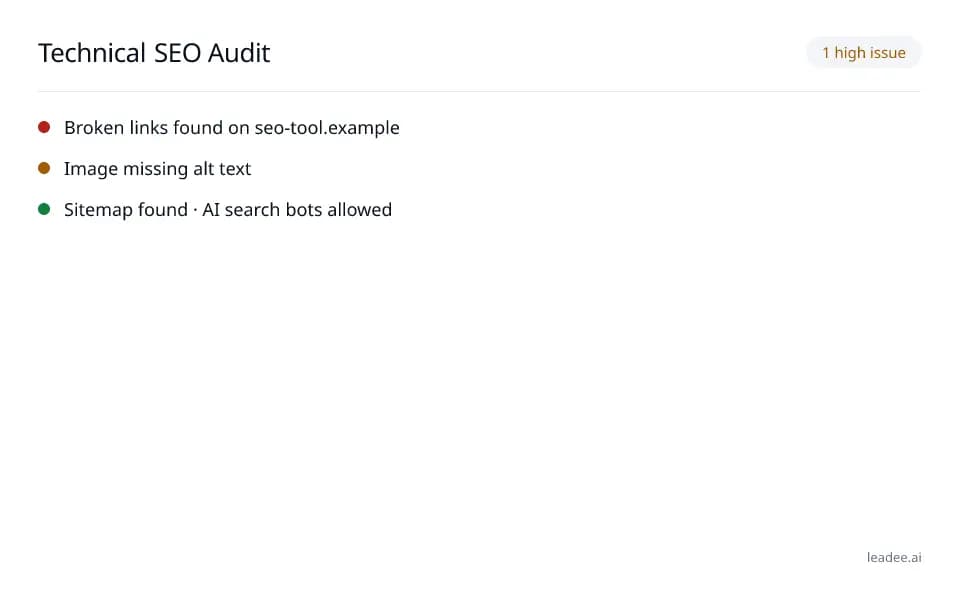
Technical SEO audit
 Free tool
Sitemap validator
 Free tool
Redirect checker
 Free tool
Meta tag checker
 Free tool
JavaScript Rendering and AI Crawlers
Check every language version, not just 20 URLs.
Leadee's technical SEO audit crawls your whole site and runs the hreflang, canonical and indexability checks across it.