
Redirect checker for browsers and AI crawlers
Enter a URL. Leadee follows its redirects one hop at a time, up to 10, as Chrome, as GPTBot and as ClaudeBot. You see the status code, target and time of every hop, the http to https and www rules, and any place where an AI crawler is sent somewhere else than a browser.
Updated
- No email needed
- Free, no sign-up
2 issues
- GPTBot ends on a different page than Chrome
- A 302 sits on the way to the main address
- No loop, no https downgrade
Example result
Run it now
At a glance
- 4 items
- What it checks
- 8
- Questions answered
- No email needed
- To get a result
- Is my site healthy?
- Answers
What does a result look like?
2 issues
- GPTBot ends on a different page than Chrome
- A 302 sits on the way to the main address
- No loop, no https downgrade
Sample from a real run, 14 Nov 2026.
What does it check?
See the full methodology at /methodology for how every Leadee check is scored and weighted.
Chrome vs GPTBot vs ClaudeBot
The same URL is followed with three User-Agents. Any bot chain that ends elsewhere, or on a block page, is flagged. Checked 14 November 2026.
301 vs 302
Each hop shows its status code. Temporary codes (302, 303, 307) on the way to the main address are flagged. Google Search Central, checked 14 November 2026.
Loops and long chains
A chain that comes back to a URL it visited, or needs more than 10 redirects, is stopped and reported. Checked 14 November 2026.
http to https
A bare domain starts on http:// so you see whether it reaches https, and no hop goes back from https to http. Checked 14 November 2026.
www rule and extra hops
Shows whether the chain adds or removes www, and flags chains with more than one redirect or that switch back and forth. Checked 14 November 2026.
Final page
The chain must end on a 2xx page. Error codes, a redirect with no Location header and meta refresh redirects are reported. Checked 14 November 2026.
OpenAI runs more than one crawler, and each one has its own job. Read OAI-SearchBot vs GPTBot vs ChatGPT-User.
How do I read and fix the result?
Start with critical and high findings: a loop, a chain that ends on an error, an https to http step, or a bot sent to a different page. Medium findings cost crawlers extra hops or send a weak signal about the main address. Low findings are clean-up. The chain tables show what each User-Agent got at every hop.
Enter a domain or a full URL. A bare domain starts on http:// so you see the https redirect.
Leadee reads robots.txt, then follows the chain as Chrome, GPTBot and ClaudeBot.
Compare the three chains. A bot chain that differs from Chrome is marked.
Fix the findings from the top down, then check the URL again.
Who is it for?

Engineering and field-service teams
Sites that must stay fast, secure and crawlable.

Local and regional printers
Small-business sites that can't afford downtime or a breach.

Distribution and logistics
Order and tracking pages that must never time out.
What are the limits?
What are the limits?
This checks one URL with at most 34 requests: robots.txt and up to 11 hops for each of the three User-Agents. The bot User-Agents are sent from our server, not from OpenAI or Anthropic, so a site that checks bots by IP address may answer the real crawlers differently. Meta refresh is read on the final page only; JavaScript redirects are not run. Results are cached for 24 hours.
Questions
What is the difference between a 301 and a 302 redirect?
A 301 (or 308) says the page has moved for good. A 302 (or 307) says the move is temporary. Google's Search Central docs (checked 14 November 2026) treat a 301 as a strong signal that the target is the page to index, and a 302 as a weak signal. Use 301 or 308 for http to https, www rules and moved pages.
How many redirects will a crawler follow?
Google's Search Central docs (checked 14 November 2026) say its crawlers follow up to 10 redirect hops by default. Other crawlers do not publish a number. This tool stops after 10 redirects too. Aim for one hop: send every old URL straight to its final address.
Why check redirects as GPTBot and ClaudeBot?
Some CDN, firewall and plugin rules look at the User-Agent. They can send AI crawlers to a block page, a login page or a different language, while browsers get the real page. Then ChatGPT or Claude reads something your visitors never see. Running the same chain three times shows where they split.
Is a different chain for a bot proof that the site treats AI crawlers differently?
It is a strong hint, not proof. We send the GPTBot and ClaudeBot User-Agents from our own server. A site that checks bots by IP address may answer the real OpenAI or Anthropic crawler differently. Check your CDN or firewall rules, or your server logs, to confirm.
What is a redirect loop?
A loop is when a chain comes back to a URL it already visited, for example http to https and back to http. Browsers show an error and crawlers give up. Loops often come from two rules that disagree, such as a CDN forcing https while the server forces http.
What is an https to http downgrade?
It is a hop from an https URL to an http URL. The page leaves the encrypted connection, and browsers may warn about it. It is usually an old rule or a hard-coded http link in the server config. Every hop should stay on https once the chain reaches it.
Should my site use www or not?
Either works. What matters is that you pick one and redirect the other to it in one permanent hop. This tool shows the www rule of each chain and flags chains that add www and then remove it, or switch between http and https more than once.
What does the redirect checker fetch from my site?
At most 34 requests: your robots.txt once, then each hop of the chain for Chrome, GPTBot and ClaudeBot. Hops to another host are followed, because your site chose that target, but private and local addresses are refused. If your robots.txt blocks crawlers like ours, we stop and tell you. No AI model is used.
Can GEO guarantee results?
No. AI answer engines change their output frequently, and no vendor — including Leadee — can guarantee a ranking or a mention. Leadee publishes confidence intervals on every metric so you can see how much a result can vary run to run.
How does Leadee measure AI visibility?
Leadee runs your prompt set against each AI engine on a weekly to daily schedule, depending on plan, through official vendor APIs (OpenAI, Gemini, Perplexity, Anthropic, DataForSEO) — never by scraping consumer chat interfaces — and reports mention rate, citation rate, average position, share of voice and sentiment with a 95% confidence interval.
Who do I talk to?
Email support@leadee.ai or use Talk to an expert at https://leadee.ai/contact-sales — the Netbase JSC team behind Leadee replies by email or WhatsApp — or WhatsApp the CEO directly at https://wa.me/84937869689.
Which tools go with this one?
- Free tool
Meta Tag Checker
Check a page's title, meta description, canonical, Open Graph and X card tags, and see how the link looks in Google, LinkedIn, Facebook, X and WhatsApp.
Learn more - Free tool
AI Bot Log Analyzer
Drop an Apache, nginx or Cloudflare log. See which AI bots visited, which pages they read, their status codes and whether each IP is in the published range.
Learn more - Free tool
hreflang Checker
Check hreflang in HTML, HTTP headers and your XML sitemap for up to 20 URLs. Find bad language codes, missing return links, x-default and canonical conflicts.
Learn more - Leadee product
AI Visibility Audit
Score how easily ChatGPT, Gemini and other AI engines can read, cite and trust your site — crawler access, schema, llms.txt and more.
Learn more
Related
 Free tool
s
 Free tool
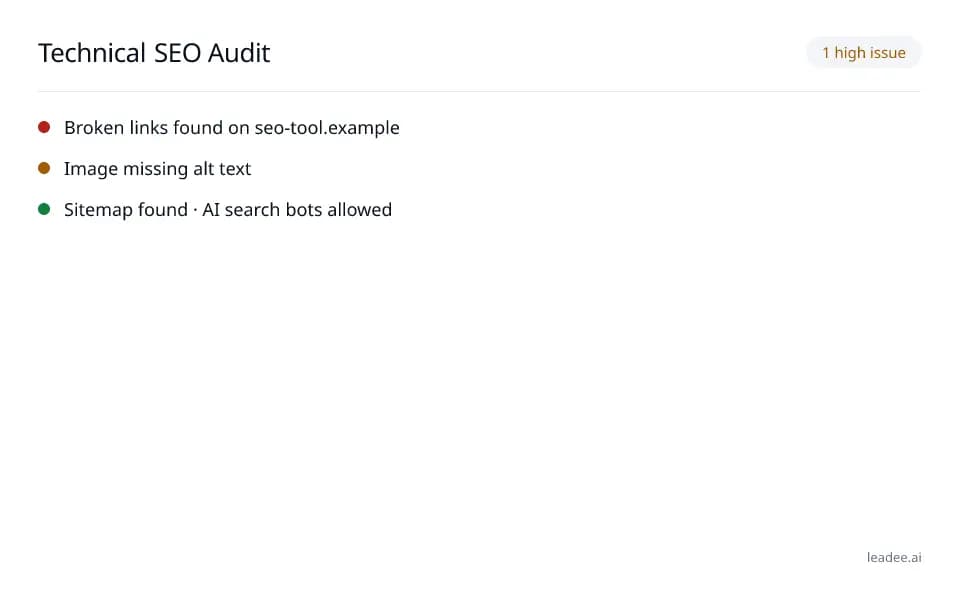
Technical SEO audit
 Free tool
ChatGPT bot access test
 Free tool
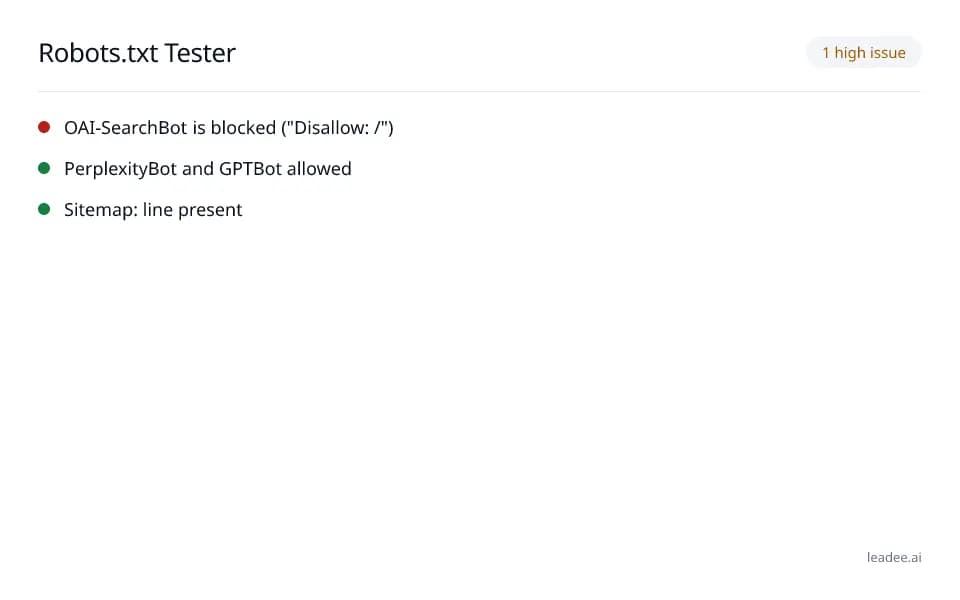
Robots.txt tester
- Platform guide
OAI-SearchBot vs GPTBot vs ChatGPT-User
 Service
Pricing
Check every page, not just one URL.
Leadee's technical SEO audit crawls your whole site and runs the https, redirect chain and bot access checks across it.