
Schema markup validator
Paste a URL or code and Leadee checks every JSON-LD, microdata and RDFa item against the full schema.org vocabulary and Google's rich result requirements, explains each error in plain words and gives you corrected code to copy — free, no sign-up.
Updated
- No email needed
- Free, no sign-up
Example result
Run it now
At a glance
- 6 items
- What it checks
- 7
- Questions answered
- No email needed
- To get a result
- Can AI read my site?
- Answers
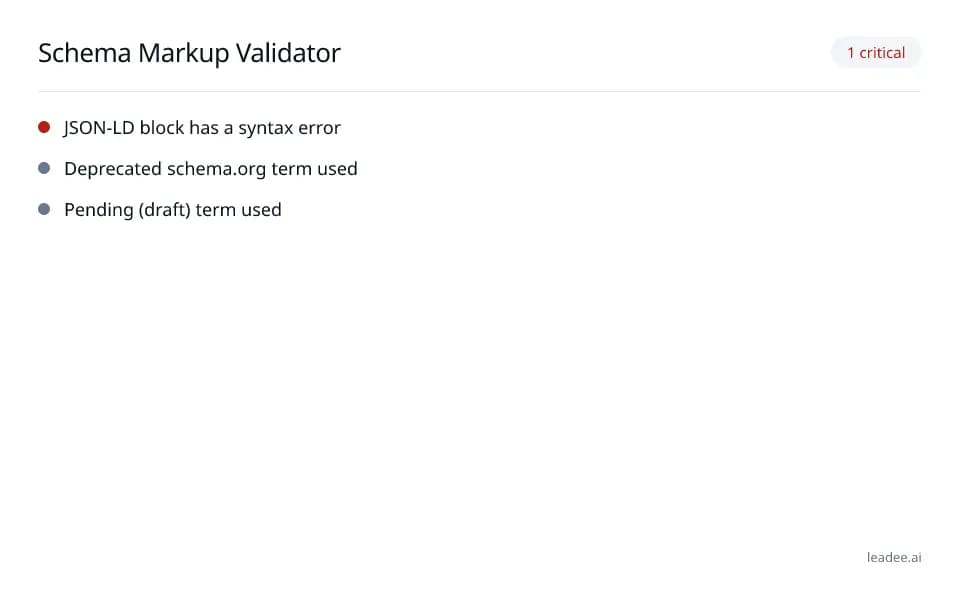
What does a result look like?
1 critical
- JSON-LD block has a syntax error
- Deprecated schema.org term used
- Pending (draft) term used
Sample from a real run, 14 Nov 2026.
What does the validator check?
Every check reads the full schema.org vocabulary and Google’s rich-result rules, each with a recorded source and the date it was last checked — see Methodology for the full list.
Syntax
JSON-LD that fails to parse, with the exact line and column. Own engine.
Vocabulary
Unknown @type/property, wrong value type, non-schema.org enum values. Full schema.org release (Apache-2.0).
Consistency
@id references to nodes not on the page; FAQ/Product/HowTo text not visible on the page. Own engine.
Deprecation
Types/properties schema.org has superseded or marked pending. Schema.org release.
Google rich results
14 features (Article, Breadcrumb, Event, FAQ, HowTo, JobPosting, LocalBusiness, Logo/Organization, Product, Merchant listing, Review, SoftwareApplication, VideoObject, Recipe) — required/recommended fields, and whether Google currently limits or has deprecated that feature. Google Search Central docs, checked the day this tool's rules were last updated.
Policy
Self-serving reviews (own business reviewing itself), FAQ text that is not visible on the page. Google structured-data policies.
How does this compare to other validators?
Google still makes the final call on rich results — this tool is a faster first pass, not a replacement for Google's own test.
| Leadee | Google's Rich Results Test | validator.schema.org | |
|---|---|---|---|
| Full schema.org vocabulary | ✓ | Only Google-supported types | ✓ |
| Google rich-result eligibility per feature | ✓ | ✓ | — |
| Explains errors in plain words + corrected code to copy | ✓ | — | — |
| Renders page JavaScript first | — | ✓ | varies |
| Account required | — | — | — |
How do I read and fix the result?
Fix the critical and high-severity issues first — a syntax error or a missing required property blocks Google rich results and confuses AI parsers outright; deprecated or pending terms are lower priority since they still parse correctly today.
Enter a page URL, or paste HTML or raw JSON-LD code.
Read the rich-result eligibility table to see which Google features your markup qualifies for.
Fix the red (critical/high) issues first — each one explains why it matters and how to fix it.
Copy the suggested corrected code, or open it in the Schema Markup Generator to edit with a form.
Re-check the corrected code to confirm the deterministic-fix issues are gone.
Save & monitor the page so Leadee flags it again if the markup breaks later.
Who is it for?

Manufacturers
Product and spec pages AI engines need to parse correctly.

Professional services firms
Service pages that need clear Organization and entity markup.

B2B suppliers
Catalogue and partner pages AI crawlers must be able to read.
What are the limits?
What are the limits?
This checks one URL or pasted code at a time, against the schema.org vocabulary and Google's documented rich-result rules — valid markup does not guarantee Google actually shows a rich result, and nothing can guarantee an AI engine cites you.
Questions
What is a schema markup validator?
A tool that reads the structured data (JSON-LD, microdata or RDFa) on a page and checks it against the schema.org vocabulary and, separately, against what Google requires for each rich-result feature — then explains what is wrong and how to fix it.
Is this the same as Google's Rich Results Test?
No. Google's Rich Results Test only checks the handful of types Google itself supports and renders the page's JavaScript first. Leadee checks the full schema.org vocabulary, explains each error in plain words and gives you corrected code — but Google still makes the final call on rich results, so confirm there too.
Why does my valid schema not show stars or FAQ in Google?
Valid schema.org markup and Google rich-result eligibility are two different things. Google deprecated the FAQ rich result from Search entirely starting May 7, 2026, after restricting it to well-known government/health sites since 2023 (https://developers.google.com/search/docs/appearance/structured-data/faqpage), has retired the HowTo rich result too, and never counts a review about your own business (the self-serving reviews policy) — your markup can be fully valid and still not earn a rich result for these reasons.
JSON-LD vs microdata vs RDFa — which should I use?
JSON-LD (a single script block) is what Google recommends and most AI engines parse most reliably, and the easiest to maintain since it is separate from your HTML (Google's structured-data guidelines: https://developers.google.com/search/docs/appearance/structured-data/sd-policies). Microdata and RDFa Lite work too and this tool checks both, but most sites should use JSON-LD unless a CMS forces microdata.
Does schema markup help ChatGPT or AI search?
It helps AI engines parse who you are and what you offer with less ambiguity — the same entity signals Leadee's AI visibility checker scores. It does not guarantee an AI engine mentions or cites you; nothing can promise that.
Can it check my whole site?
This free tool checks one URL at a time. Create a free account to check every page from your sitemap and get notified when markup breaks.
What happened to the Structured Data Testing Tool?
Google retired its original Structured Data Testing Tool in 2021 in favor of the Rich Results Test; validator.schema.org (an independent, community-run tool) picked up the general schema.org-vocabulary checking the original tool did.
Can GEO guarantee results?
No. AI answer engines change their output frequently, and no vendor — including Leadee — can guarantee a ranking or a mention. Leadee publishes confidence intervals on every metric so you can see how much a result can vary run to run.
How does Leadee measure AI visibility?
Leadee runs your prompt set against each AI engine on a weekly to daily schedule, depending on plan, through official vendor APIs (OpenAI, Gemini, Perplexity, Anthropic, DataForSEO) — never by scraping consumer chat interfaces — and reports mention rate, citation rate, average position, share of voice and sentiment with a 95% confidence interval.
Who do I talk to?
Email support@leadee.ai or use Talk to an expert at https://leadee.ai/contact-sales — the Netbase JSC team behind Leadee replies by email or WhatsApp — or WhatsApp the CEO directly at https://wa.me/84937869689.
Related
 Free tool
s
 Free tool
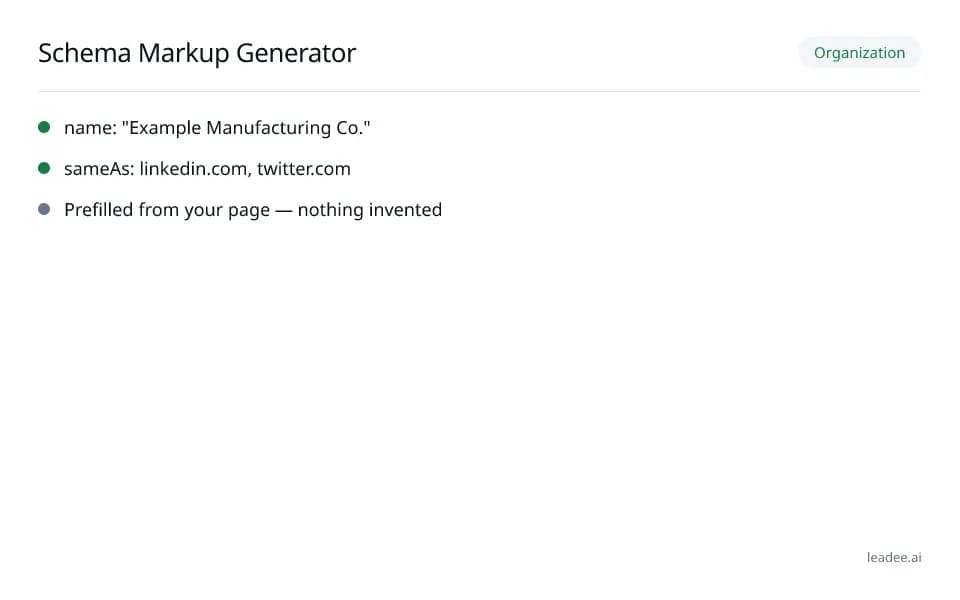
Schema markup generator
 Free tool
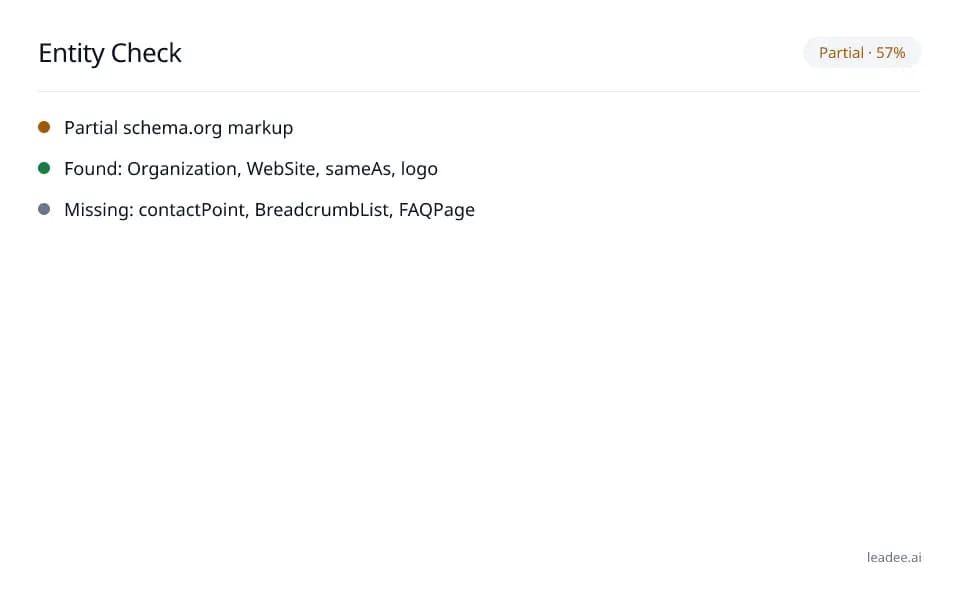
Entity check
 Free tool
Schema Markup for B2B Sites
 Service
Pricing
 Proof & trust
Methodology
Keep this markup correct as your site changes.
Leadee tracks your markup alongside the rest of your AI visibility and flags it when something breaks.